




Multi Cloud Deployment Optimization Guide

What is Multi Cloud Deployment?
Multi cloud deployment, or simply just multi cloud, is a method of cloud computing delivery in which an organization utilizes at least two cloud providers for their operations. Typically being a combination of public and private cloud, the multi cloud approach gives users the ability to pick and choose desired services from each provider, creating a strategy that is unique to their needs.
Cloud providers often have a bad rap when it comes to specific services. While cloud services are undoubtedly powerful and convenient, there have been countless instances of cloud users being surprised by overprovisioned resources, high cloud bills, and worst of all, vendor lock. In an industry where a couple of cloud providers reign supreme, multi cloud deployment represents a light at the end of the tunnel. The multi cloud approach offers a solution to the ongoing problem of cloud rigidity, offering increased flexibility and customizability without additional complexity.
There’s no wonder why 33% of organizations have shifted to deploying on multiple clouds instead of relying on one. However, many of these organizations find managing multi cloud deployments challenging. Multi cloud deployment optimization utilizes automation, standardization, monitoring, and more tech to bring together complex clouds into a single, streamlined solution.
The Benefits of Multi Cloud Deployments
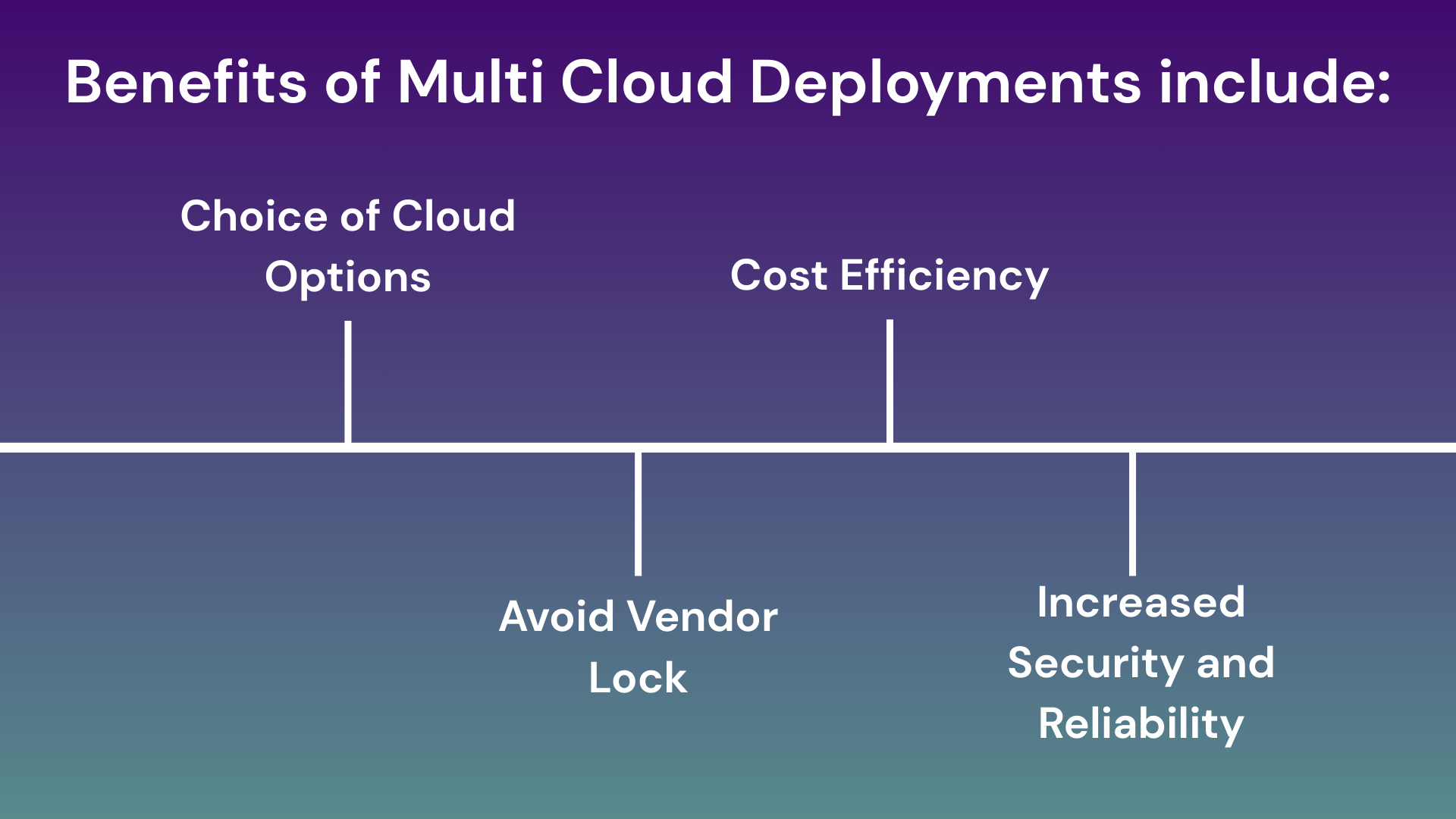
The multi cloud deployments model is by far one of the most flexible cloud computing models, offering users the utility of multiple clouds without the commitment of a single cloud. For that reason being, the multi cloud approach offers users unique benefits pertaining around flexibility, including:
The Choice of Cloud Options
As the name suggests, multi cloud deployments mobilize multiple clouds. While this statement seems cut and dry, the uniqueness of it lies within the user’s ability to choose the best services from each provider and use them in congruence with their entire cloud operation. Users can create a strategy that involves services unique to only certain providers combined with solutions that are widely accessible. Multi cloud encourages specific customization like no other, enabling a cloud strategy that meets specific app needs the most while encouraging the diffusion of diverse and innovative tech from each cloud provider.
Avoid Vendor Lock
The choice of multiple clouds also helps users avoid vendor lock in, a common occurrence with single cloud providers.
Vendor lock occurs when cloud providers offer proprietary tech and cloud services to cloud users, consequently ‘locking’ these users in with specialized tech, high egress fees, and more. Users that are vendor locked are subject to any price and operation changes the cloud provider sees fit, regardless of original pricing model.
The multi cloud approach combats this by mobilizing multiple clouds, with reliance being spread across an entire fleet of clouds rather than a single provider. This aspect enables users to use services only offered outside of their original cloud provider as well, creating a unique cloud experience that is not bound to a single cloud.
Cost Efficiency
Utilizing more than one cloud removes a lot of the overhead associated with a single provider, as well as the worry of physical machinery and maintenance. This, along with the mixing and matching of services according to price and performance ratio, gives multi cloud users optimized spending.
Cloud services also scale up and down efficiently (and often automatically). Multi cloud users can scale according to their needs, spending no more than what is required.
Increased Security and Reliability
Each cloud provider has their own security standards, often meeting with or exceeding industry standards and meeting governance requirements.
If outages or downtime occur within one provider, user applications and operations can seamlessly migrate to another provider, reducing the risk of a single point of failure. For users looking to further increase their fault tolerance, refer to this guide!
The benefits of multi cloud revolve around the choice of multiple cloud services given to multi cloud users. Because of this customization freedom, users can combat vendor lock, increase their security, and significantly improve their cost efficiency.
Multi Cloud Deployment Challenges
Multi cloud deployment gives users ‘more’: more clouds, more services, more freedom and choices. However, ‘more’ might not be the best option, depending on the application and user.
Multi cloud deployment challenges include:
Management Complexity
Having more clouds under your belt can be great, if you can manage them correctly. Multi cloud users have reported significant challenges in managing multiple clouds due to their individuality. Each cloud comes equipped with their own platforms, UI, APIs, plugins, and so on. The more clouds you onboard, the more complex your cloud operations become.
The complexity of management becomes further complicated when considering compatibility issues cloud providers may have.
Potential Compatibility Issues
As mentioned, cloud providers, although nearly similar in intention, differ in terms of operations. Tons of distinctions can be made between providers, from environment configuration and APIs, to service offerings and data storage, no two providers are the same. Configuring your cloud operations and tech stacks to support multiple clouds and data sharing can be a struggle, even for the most seasoned cloud veteran. Complex configuration may also highlight potential skill gaps and may require additional headcount to solve.
Maintaining Security
While each cloud may have their own security measures, this does not mean that your application is absolutely secure.
Gaps in security during things like data transfer and with operations across clouds exist, it is important to onboard extra security when working with multi cloud deployments.
Despite the benefits of multi cloud stemming from the options of cloud, many of the challenges associated with this approach also come from the options of cloud. Users seeking a multi cloud deployment should be prepared to tackle management and compatibility issues, with new hires being a potential solution.
Multi Cloud Application Deployment Optimization Strategies
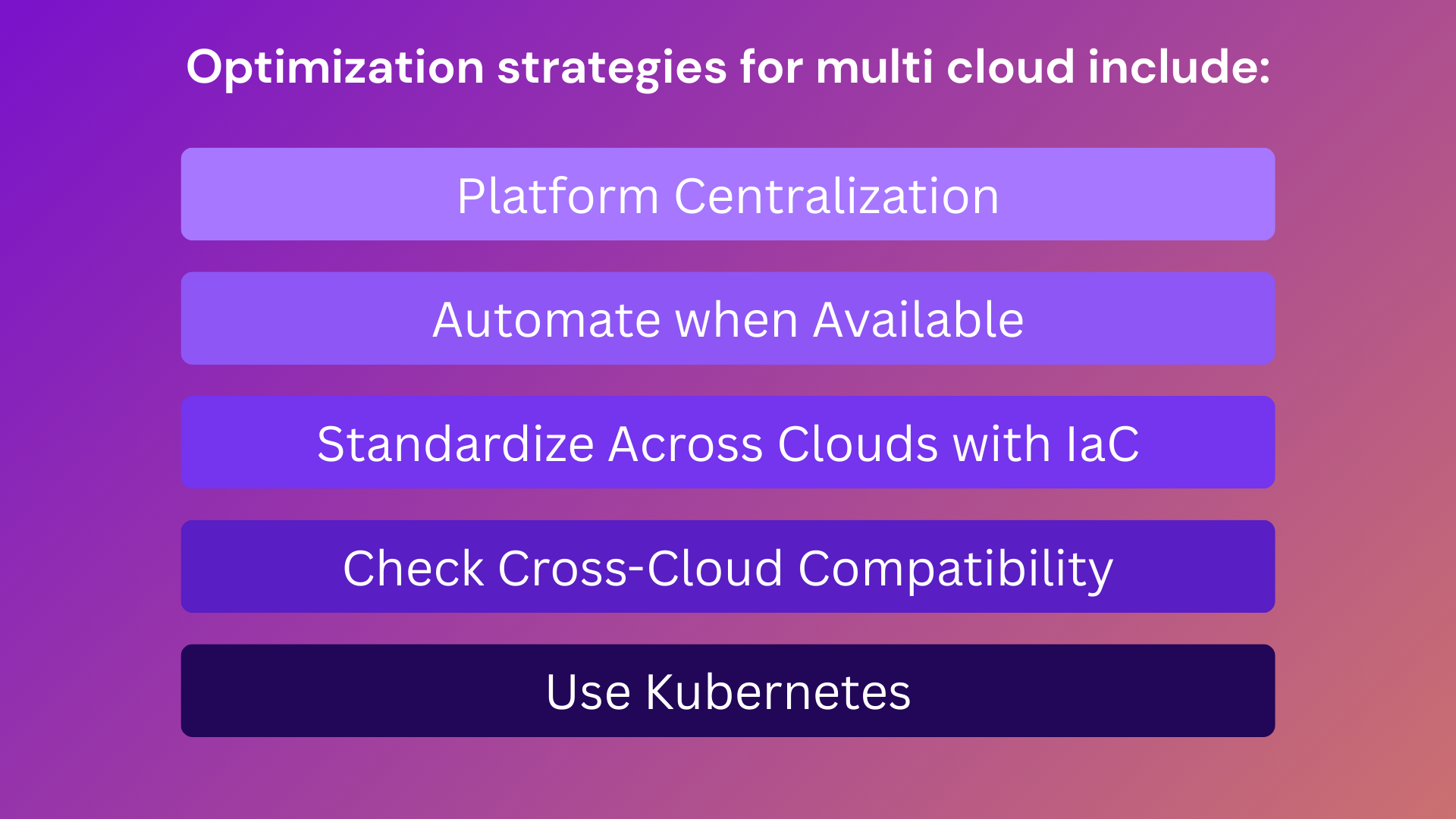
In order to optimize a multi cloud deployment while addressing many of the challenges this approach creates, teams should prioritize these central aspects in their system configuration:
- Centralization
- Automation
- Standardization
- Compatibility
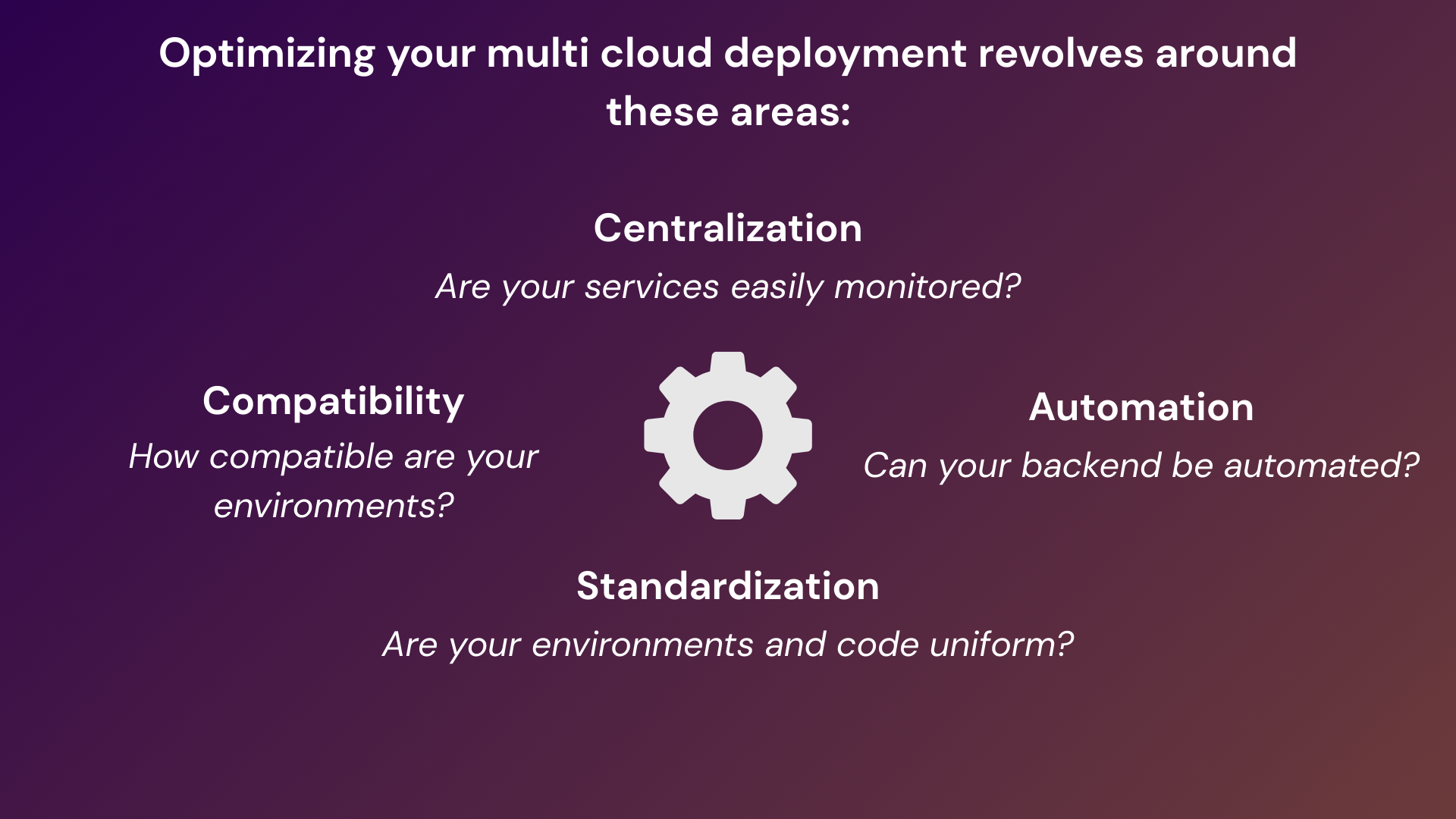
Optimization strategies for the multi cloud deployment approach include:
Platform Centralization
The multi cloud approach onboards the best of different clouds, and while this is a huge draw towards the approach, this is also one of the biggest contributors to the challenges of multi cloud.
In order to better manage multiple clouds, teams should be utilizing centralized cloud management platforms, such as the one offered by Lyrid. Platforms or interfaces of this nature typically offer cross-cloud monitoring and cluster management, centralizing visibility across all clouds. Users can access individual cloud performance, cost, security, usage, and more metrics within a single pane of glass, reducing the risks of cloud blind spots while enhancing management and insights.
Automate When Available
Many of the processes within the cloud can be automated, with automation reducing human error and increasing efficiency and developer productivity. The key to a successful multi cloud approach sees automation being integrated across all disciplines, including:
- Scaling: automatically allocate and deallocate resources for better cost efficiency
- Failovers: automatically transfer applications from one service to another when problems arise
- Provisioning: automatically manage user access
And other repeatable tasks.
Automation performance can be regularly monitored and adjusted based on desired state as well, giving developers more time and bandwidth to work on mission critical projects.
Standardize Across Clouds with IaC
A problem within multi cloud deployments is that no two clouds are alike, the same goes for their specific architectures and deployment styles. Utilizing Infrastructure as Code (IaC) provides standardization through consistent templates and policies, ensuring that environments are uniform across providers. Using IaC can also reduce human error and provide consistent application baselines through version control and easily reproducible environments.
Cross-Cloud Compatibility
To ensure that all clouds are working properly, teams should frequently test the compatibility between applications and APIs across all cloud environments. Teams can do so through test environments and test cases, utilizing tools like Sauce Labs, BrowserStack, and Apache JMeter to ensure that applications are performing within different clouds.
Use Kubernetes
Kubernetes is a powerful container orchestration platform that enables teams to deploy, scale, and manage containerized applications. In the scope of multi cloud deployment, Kubernetes supports workload portability, automated resource allocation, enhanced security and backup measures, and more. Kubernetes is a powerful option for multi cloud, with the combination of the two supporting the operations of companies like JPMorgan and Amazon.
Kubernetes Multi Cloud Deployment with Lyrid
Multi cloud deployment involves deploying applications across more than one cloud, utilizing the best that each cloud has to offer. Because of this, benefits of multi cloud deployments include increased flexibility, customizability, and cost efficiency, at the cost of management complexity, consistency errors, and potential skill gaps. That being said, to further optimize a multi cloud deployment, teams should be prioritizing centralization, automation, standardization, and compatibility within their multi cloud strategies. For teams looking for further portability and flexibility, look towards Kubernetes.
Multi cloud Kubernetes platforms with automated deployment features are all the rage, especially when it comes to enhancing the multi cloud experience. The problem is that multi-cloud Kubernetes deployments can be complex to operate; Kubernetes is notoriously difficult to use and requires some expertise. Or, you could use Lyrid Managed Kubernetes.
The Lyrid platform offers multi cloud Kubernetes that combines that utility of multiple cloud providers with the scalability and flexibility of Kubernetes deployments into a single platform. Through Lyrid, users can mobilize the best of cloud as well as bare metal servers, with features such as:
- Automated resource allocated
- Automated cluster scaling
- Centralized cluster visibility
- Streamlined deployment through Helm Chart
And more being offered within Lyrid’s base offerings.
Interested in learning more about Lyrid multi cloud Kubernetes? Book a free demo with one of our product specialists!


99 South Almaden Blvd. Suite 600
San Jose, CA
95113

Jl. Pluit Indah 168B-G, Pluit Penjaringan,
Jakarta Utara, DKI Jakarta
14450

Rhapta Road, Westlands,
Nairobi
00800


99 South Almaden Blvd. Suite 600
San Jose, California
95113
Jl. Pluit Indah 168B-G, Pluit Penjaringan,
Jakarta Utara, DKI Jakarta
14450
Watermark Business Park, Lagoon Court,
Ndege Road,
Karen, Nairobi
00509