




What is Elasticity in Cloud Computing? The Practice Saving Your Application (and Wallet)


What is Elasticity in Cloud Computing?
Elasticity in cloud computing refers to an aspect of the cloud to grow or decrease resources consumed without affecting any services currently in operation. These resources include CPU, memory, and storage, shifting within a moment’s notice and encouraging adaptability in everchanging markets.
The primary focus of cloud elasticity is to meet unexpected demand spikes competently and without onboarding additional equipment to handle demand. Resource allocation / deallocation through cloud elasticity can be conducted either manually or automatically, with cloud elasticity itself referring to two different methods:
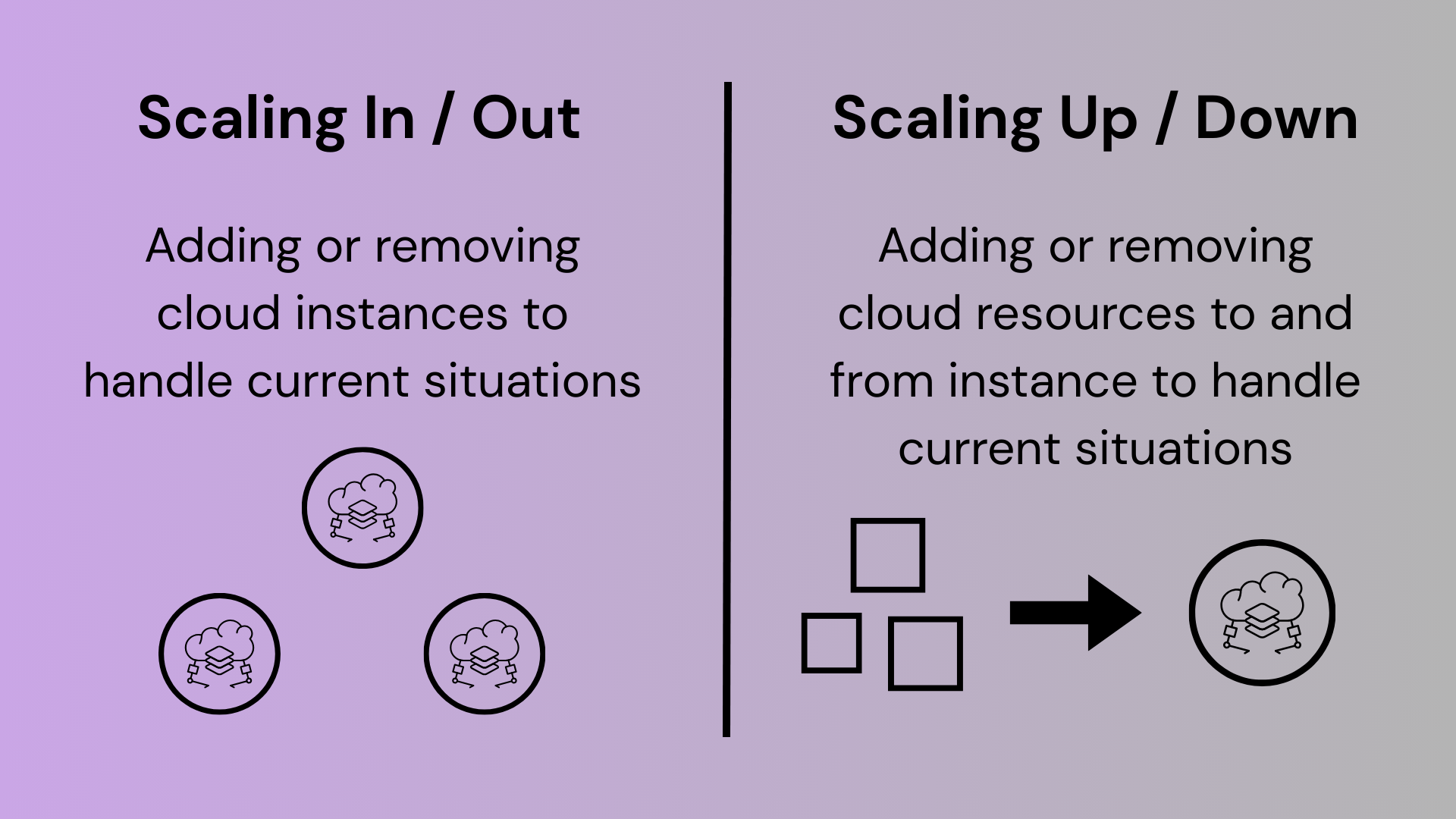
- Scaling In / Out: Adding or removing cloud instances to handle current situations
- Scaling Up / Down: Adding or removing cloud resources to and from instance to handle current situations
Though cloud elasticity is often associated with scaling out.
There is also a form of cloud elasticity known as cloud bursting that sees entire loads move from private clouds to public clouds to reduce system stress during times of peak demand.
That being said, how does cloud elasticity work?
How Cloud Elasticity Works
As mentioned above, cloud bursting is a form of cloud elasticity that shifts workloads rather than adjusts resources. This process is typically done manually. But how does a cloud provider go about automatically shifting user resources while ensuring that services are not disrupted?
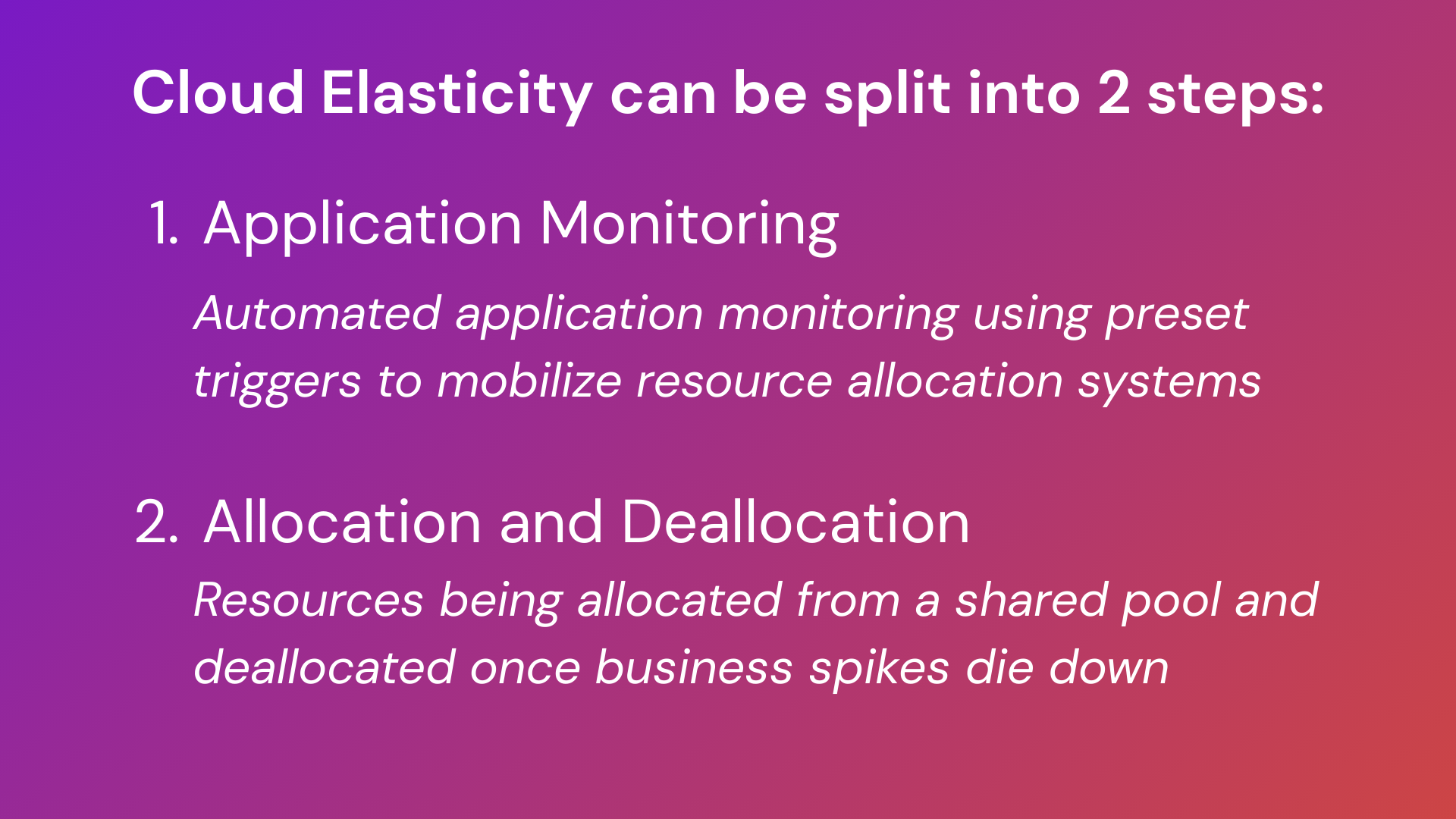
A manual allocation approach requires analyzing resource use trends and allocating resources based on that data. Automatic allocation can be split up into two steps:
Application Monitoring
This step requires automated application monitoring, specifically within an application’s performance and resource usage. Based on triggers set by the overarching cloud service provider, monitoring systems will engage resource allocation or deallocation.
Allocation and Deallocation
Once application performance and usage drop below preset thresholds, resources will automatically be allocated from a pool of resources offered by the cloud provider, accessible within minutes. The same action is applied once business spikes die down: resources are automatically deallocated to keep costs down.
Automated cloud elasticity is advantageous because it removes the need for standby capacity. The manual approach does require having resources at hand and may actually cost more than automatic allocation, though necessity varies based on the nature of the application, team size, available resources, and more.
Cloud elasticity is critical in most, if not all, cloud operations because it helps organizations stay within a feasible resource consumption range. Companies that overprovision resources will find themselves spending way more money than necessary, wasting resources on idle actions. However, organizations that underprovision resources may find themselves unable to serve demand, leading to possibly worse implications and loss of business.
Elasticity in Cloud: Benefits and Challenges
Benefits of Cloud Elasticity
Like all cloud processes and applications, cloud elasticity has benefits that can greatly impact system health and operations. The most obvious of these benefits is automated scaling, but other benefits of cloud elasticity include:
Increased Agility
With automated cloud elasticity, users no longer have to manually provision resources with extra servers on standby, but rather automatically allocate them based on desired state within minutes.
Stronger Cost Savings
Many cloud providers offer a pay-as-you-go model, meaning users pay only for the resources they use. Elastic cloud computing allocates the right amount of resources needed and deallocates when demand drops, ensuring that no resources are wasted.
Enhanced Reliability
Resource scaling in times of need increases an application’s uptime and fault tolerance, ensuring that operation persists and business continuity is maintained. Cloud elasticity does much more than just move resources around however; the risk of system overload is mitigated through automated resource allocation. No longer is the stress placed upon a singular system, but spread across multiple clouds through techniques like cloud bursting.
Powerful Efficiency and Performance
The benefits of automated resources adjustments on operations are twofold, offering a strong hand in the efficiency sector while significantly increasing performance.
With automated allocation, IT staff no longer has to keep a watchful eye on monitoring systems and app usage. Instead, these teams can focus on instrumental tasks and development.
Application performance and speed are significantly increased with optimal resource allocation, even translating to faster time-to-market for new releases and updates.
Challenges of Cloud Elasticity
However, with all cloud processes and applications, there are certainly some drawbacks that ensue. Challenges of cloud elasticity include:
Security
With any scaling operation, adding or subtracting resources can negatively impact existing workflows if misconfigured, even damaging applications as a result.
Cloud Vendor Lock-In
A prevalent issue in any cloud operation, vendor lock-in describes organizations being locked into a specific cloud for a variety of reasons. Ranging from things like proprietary tech to data egress challenges to even contracts, vendor lock-in can negatively impact an organization's cloud experience and may even cost that organization tons of capital down the line.
Despite the benefits of cloud elasticity, it is no exception to the vendor lock-in issue.
Data and Application Transfer Management
With any transfer of data or applications there are bound to be problems and incurred costs, especially when it pertains to big data and mission critical applications.
Use Cases for Cloud Elasticity
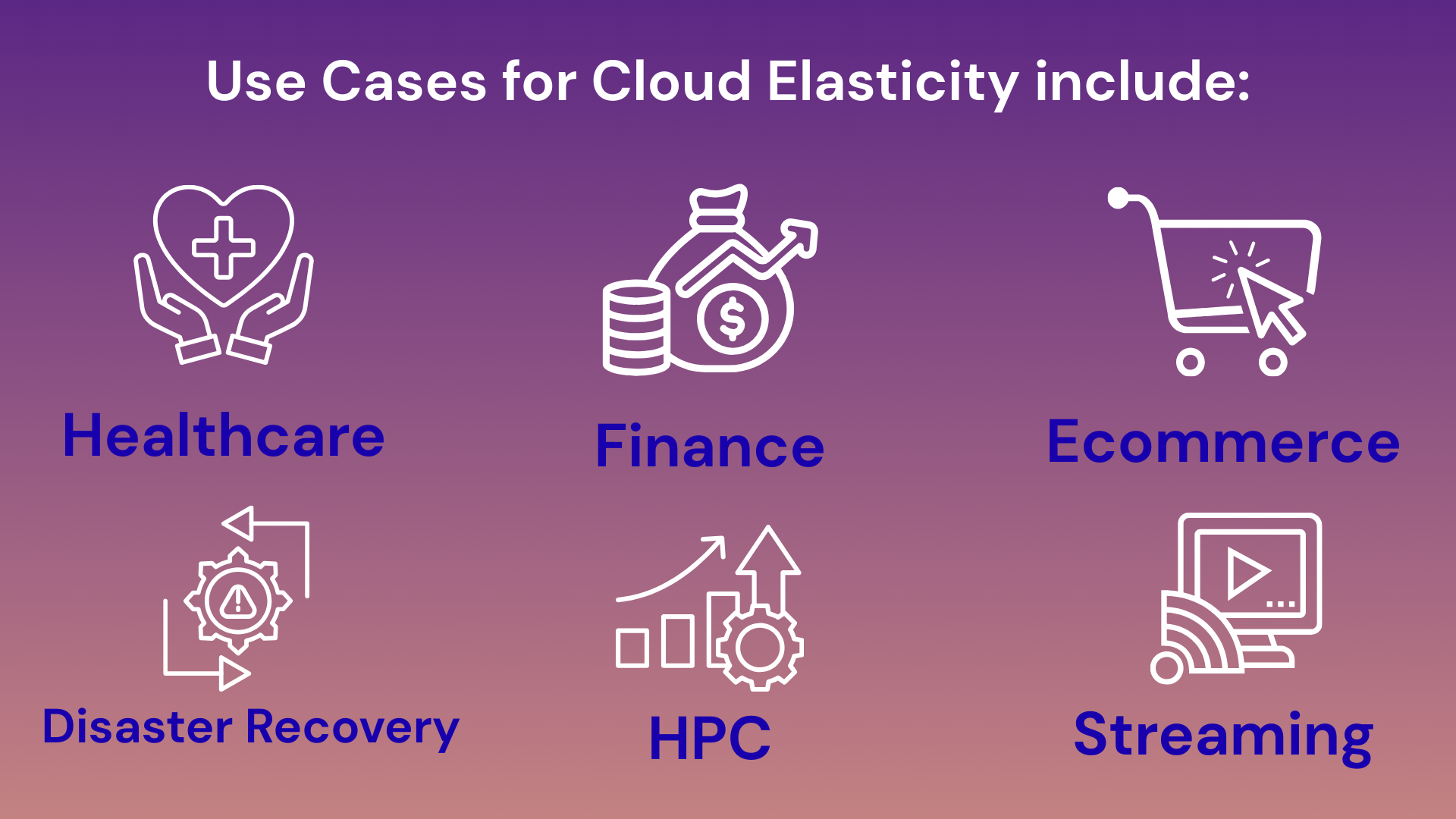
Cloud elasticity is applicable for almost all applications, no matter the size of purpose. Specific applications and industries that take advantage of elastic cloud the most include:
- Healthcare services, specifically telemedicine
- Financial services
- Ecommerce platforms / retail busy seasons
- Disaster recovery and backup systems
- HPC systems and flexible development
- Streaming services
These industries experience frequent, but unpredictable traffic spikes, making automated elastic cloud and automated resource deallocation the perfect solutions for scalable operations.
Cloud Elasticity vs Scalability
If you’re reading this, you’ve probably heard of cloud scalability as well. Cloud elasticity and cloud scalability sound pretty similar: both entail scaling resources up and down, often automatically and in response to demand spikes. However, the difference between elasticity and scalability in cloud computing lies behind the nature of scaling and an underlying baseline of resources that applications and systems have.
Cloud elasticity is a dynamic process that is often automated, with elasticity referring to a system’s ability to increase and decrease resource usage in response to increased demand. Elastic cloud has a resource baseline that it strives to maintain, straying only when necessary, and is therefore short-term in its goals.
On the other hand, cloud scalability refers to a system’s ability to meet demand. This may be short-term, but has long-term implications. Scaling cloud is typically manual and sets up an application or system for later success and growth by scaling compute, storage, and memory resources and keeping them. Cloud scalability is a planned out action rather than a dynamic response, but can meet demand even in the most random scenarios.
Despite the subtle nuances between the two, both cloud computing scalability and elasticity are viable options in preparing your application for anything thrown at it.
Elastic Cloud Computing with Lyrid
Elastic cloud computing refers to the ability of a cloud to increase or decrease resources used based on demand, without affecting any of the operating services. With both manual and automatic options available, cloud elasticity is a beneficial practice for most organizations, increasing agility, reliability, and cost savings as a result. However, users have noted security challenges and vendor lock as a few of the challenges of dealing with elasticity.
Achieving elasticity in cloud computing is as easy as working with a cloud provider, however, maintaining reliable scalability without the vendor lock-in aspect of cloud computing can be tough. Lyrid offers elastic cloud solutions, strong security, and a speed-focused approach to development and deployment within a single platform.
Through Lyrid’s hybrid cloud approach, users can competently bounce their workloads between on-premise and private/public cloud deployments, offering horizontal scaling that meets all operational requirements. Lyrid’s cloud network ensures that users are not locked into a single cloud when working within the cloud, letting users pick and choose between the best deployment options at competitive prices.
Interested in learning more about how Lyrid.io encourages cloud elasticity and flexibility? Book a free demo today, or schedule a guided product tour with one of our product specialists!


99 South Almaden Blvd. Suite 600
San Jose, CA
95113

Jl. Pluit Indah 168B-G, Pluit Penjaringan,
Jakarta Utara, DKI Jakarta
14450

Rhapta Road, Westlands,
Nairobi
00800


99 South Almaden Blvd. Suite 600
San Jose, California
95113
Jl. Pluit Indah 168B-G, Pluit Penjaringan,
Jakarta Utara, DKI Jakarta
14450
Watermark Business Park, Lagoon Court,
Ndege Road,
Karen, Nairobi
00509